
Short answer: yes. A whole-house repipe requires a plumbing permit in virtually every California jurisdiction, and any contractor who offers to skip it is offering you a liability, not a discount.
The longer answer is worth reading, because the permit process is simpler than most homeowners fear and the consequences of skipping it are worse than most realize.
What we’ll cover:
- When a permit is required and when it isn’t
- Who pulls it and what the process looks like
- Permit costs across California jurisdictions
- The inspection sequence you’ll go through
- What happens if you skip it
Repiping is all we do at OC Repipes, and we pull permits on every job. Here’s how it works.
TL;DR: California Repipe Permits
| Question | Answer |
|---|---|
| Permit required? | Yes, for whole-house repiping |
| Who pulls it? | Your licensed contractor, not you |
| Typical cost | $75 to $500, varies by city |
| Application | Online in most California jurisdictions |
| Inspections | Rough-in before walls close, then final |
| Minor repairs? | Usually exempt |
| Skipping it? | Risks insurance denial and resale problems |
When California Requires a Plumbing Permit
The California Plumbing Code treats work that alters existing piping differently from simple repairs. That distinction decides whether you need a permit.
A permit is required for:
- Whole house repiping and replacing concealed water supply lines
- Rerouting or upgrading water lines throughout the home
- Water heater replacement, California’s highest-volume plumbing permit type
- Drain lines and sewer work
- Water service projects from the meter to the house
- Gas line work
A permit generally isn’t required for:
- Repairing a single leaking pipe
- Unblocking drains
- Replacing a faucet, toilet, or similar existing fixtures
- Installing a garbage disposal
The rule of thumb: if pipe is being replaced inside walls where nobody can inspect it afterward, the local building department wants eyes on it first.
Permitting regulations do vary by local jurisdiction. Los Angeles pulls through LADBS; San Jose and Orange County cities run their own departments, and fees differ accordingly. Your contractor should know your specific city’s requirements.
Who Pulls the Permit
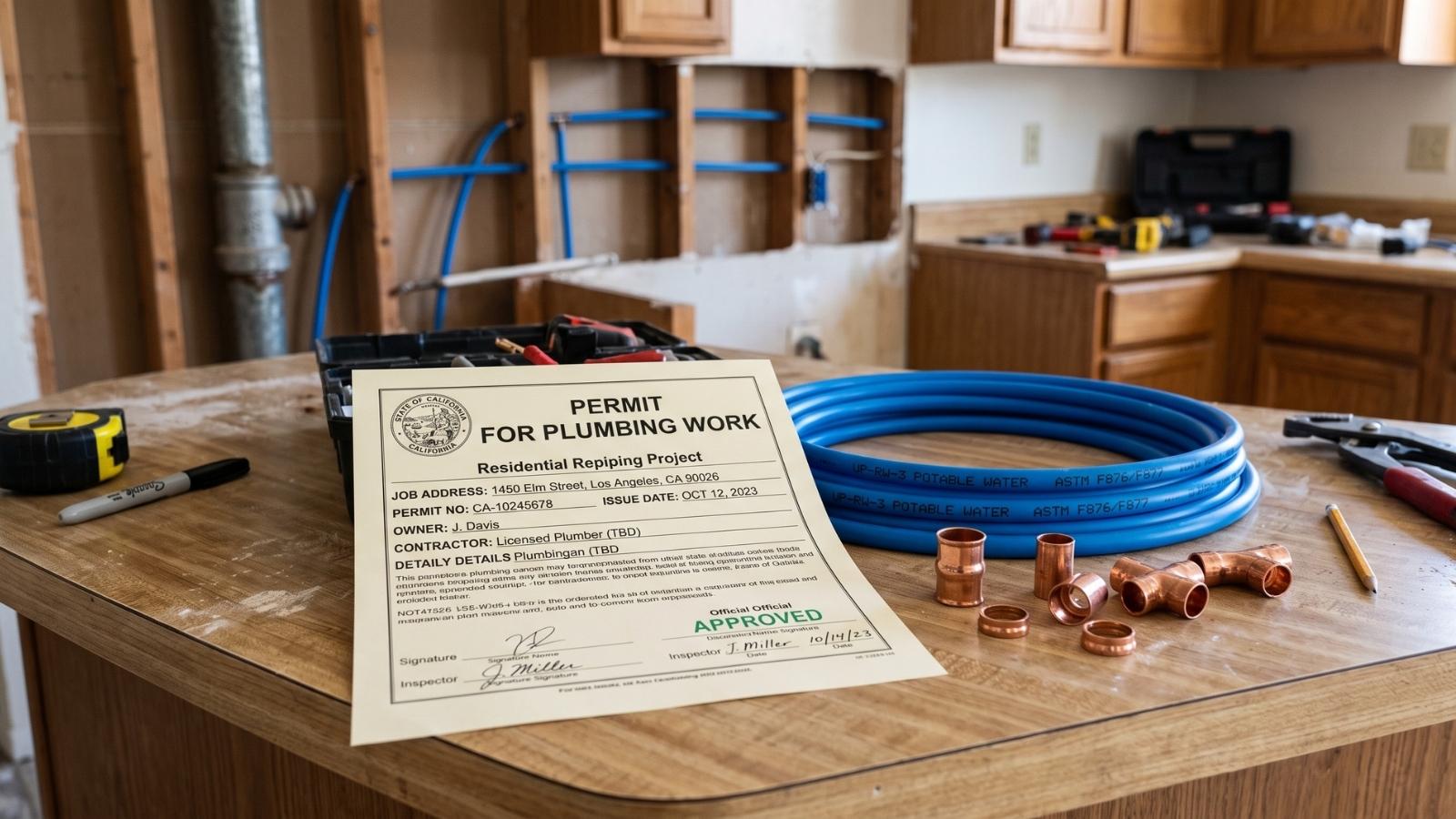
In nearly every case, your licensed contractor pulls the plumbing permit on your behalf. They file the application with their C-36 license number, pay the fee, and schedule the inspections.
That’s the arrangement you want. A contractor pulling the permit takes on accountability for code compliance and inspection scheduling.
You can pull an owner-builder permit yourself, but understand what that means: you assume the legal responsibility and financial risk for the entire job. If something fails later, it’s on you, not a contractor’s license.
Red flag: Any contractor who suggests skipping the permit to save money is telling you they’d rather avoid an inspector’s eyes on their work. That should end the conversation.
What the Permit Process Involves
The permit process is more paperwork than obstacle. Most California cities accept applications online.
How it typically flows:
- Application submitted with contractor license, project scope, and property details
- Plans reviewed by the local building department, with scope of work, pipe material, and pipe sizing verified
- Permit issued, usually within days for a standard repipe
- Work begins once approval is in hand
- Rough-in inspection before walls close
- Final inspection to close out the permit
Incomplete applications are the most common reason for rejection. Missing license numbers, vague scope descriptions, and unspecified materials send it back.
One extra note: if the repipe affects structural components, a building permit may be required alongside the plumbing permit. Rare for standard repipes, but worth asking.
Permit Costs in California
Fees vary widely by California jurisdiction, and your city’s method matters.
| Scenario | Typical Range |
|---|---|
| Standard plumbing permit | $75 to $350 |
| Whole-house repipe permit | $100 to $500 |
| Higher-cost metros | $250 to $1,200 |
Some municipalities charge a flat fee. Others calculate it based on fixture count or total project value, so a larger home with more bathrooms costs more.
Against a repipe that runs several thousand dollars, the permit is a small line item. Reputable companies include the permit cost and coordinate the required inspection as part of the quote, rather than surprising you with it later. That’s how we handle it on every repiping project we run.
The Inspection Sequence

Inspections happen at specific stages, and the sequence exists for a reason.
- Rough-in inspection: A city inspector reviews the installed piping before any drywall goes back up. They verify approved materials, correct pipe sizing, proper support and connections, and that the system passed pressure testing.
- Final inspection: After the job is complete, a final inspection verifies everything was finished correctly and closes out the permit.
What the inspector checks:
- Approved materials compliant with the California Plumbing Code
- Pipe sizing appropriate to fixture demand
- Proper support and secure connections
- Pressure testing results confirming no leaks
- Venting where applicable
That closed-out permit is your documentation. Keep it, because buyers and title companies increasingly verify permit history at resale.
What Happens If You Skip It
The real consequences of unpermitted plumbing work:
- Insurance claim denials: If unpermitted plumbing fails and causes water damage, your insurer will investigate whether the work was permitted. If it wasn’t, the claim can be denied.
- Resale disclosure problems: California law requires sellers to disclose known code violations. Unpermitted work surfaces during escrow and can kill or delay a sale.
- Retroactive permit costs: After-the-fact permits take longer and cost far more than pulling one upfront, sometimes running into thousands.
- Municipal fines: Unpermitted sewer work can trigger fines from the sewer authority on top of building department penalties.
- Contractor discipline: Contractors face disciplinary action for unpermitted work, which tells you how seriously the state treats it.
The math nobody runs: A $300 permit versus a denied water damage claim on a $40,000 loss. Skipping the permit isn’t saving money, it’s trading a certain small cost for an uncertain large one.
Permits Handled for You at OC Repipes
Permits aren’t red tape. They’re the mechanism that confirms your new plumbing was installed correctly by a licensed professional, with a city inspector verifying it before anything gets sealed inside a wall.
Quick recap:
- Required: Yes, for whole-house repiping in California
- Exempt: Minor repairs, fixture swaps, drain clearing
- Who pulls it: Your licensed contractor, with their license on the line
- Cost: Typically $75 to $500, more in some metros
- Inspections: Rough-in before walls close, plus final sign-off
- Skipping it: Risks your insurance coverage and your home sale
Since repiping is the only thing we do, OC Repipes handles permits, inspection scheduling, and code compliance on every project, bundled into one flat rate with drywall repair, cleanup, and a Lifetime Warranty on workmanship. You never touch a permit form.
Frequently Asked Questions
How much does it cost to repipe a house in California?
California repipes typically run $8,000 to $25,000, higher than the national average due to labor rates. Home size, fixture count, foundation type, and material drive the final number.
Can you sell a house with unpermitted work in California?
Yes, but California law requires you to disclose known code violations. Unpermitted plumbing often reduces offers, delays escrow, or forces retroactive permitting before closing.
What can a homeowner do without a permit in California?
Minor repairs generally don’t require a permit: fixing a leaking pipe, clearing a blocked drain, replacing a faucet or toilet, or installing a garbage disposal.
Do I need to repipe my house?
Consider it if you have recurring leaks, discolored water, low water pressure across fixtures, or a pre-1970 home with original galvanized steel piping.
How long does it take to get a repipe permit?
Most California cities issue plumbing permits within days when the application is complete. Incomplete applications are the top cause of delay, which is why contractors handle them.
Does a permit cover drywall repair too?
No. The plumbing permit covers the piping work and inspections only. Drywall repair is a separate line item, so confirm whether your contractor includes it.
